
Vegetable Oils Bad!
Avoid Vegetable Oils
Vegetable oils are really bad for you. This is a TLDR version of Jeff Nobb’s wonderful posts on the dangers of vegetable oils.

Despite food messaging often feeling like this sign, Americans are making a genuine effort to get healthier.
Americans are eating better - consumption of saturated fat, sodium, red meat, carbohydrates and sugar have all decreased in the last couple of decades.
They’re also making better lifestyle choices - people smoke and drink less while exercising more.
But despite this, Americans are sicker than ever. Since 2000, the percentage of adults with at least one chronic disease has grown from 45% to 60%.
So people are eating better, exercising more, and drinking and smoking less, but are still getting sicker. So who or what is to blame?
Vegetable oil.
What is vegetable oil and why is to blame?
Vegetable oils include safflower oil, soybean oil, sunflower oil, corn oil, canola oil, peanut oil, rice bran oil, grape seed oil, and cottonseed oil. Almost non-existent 100 years ago, vegetable oil consumption has grown 150x since 1909 and now accounts for 20% of the daily calories of Americans.
They are the result of intensive processing techniques and allow companies to turn otherwise useless products (ex. grape seeds, sunflower seed shells, rice skin) into a $100 billion industry.
"We hid seed oils in everything and then convinced everyone that butter & steak causes the problems" pic.twitter.com/bntlc1AZTO
— Carnivore Aurelius ©🥩 ☀️🦙 (@AlpacaAurelius) December 9, 2021
We can deduce that vegetable oils are a major driver of disease for two main reasons.
- The strong correlation between the increased consumption of vegetable oils and the rise of chronic disease.
- Randomized studies that clearly demonstrate the deadly effects of vegetable oils.
Remember, while drinking, smoking, meat consumption, sodium intake and inactivity have all decreased or remained constant, the rise in consumption of vegetable oil has exploded and gone hand-in-hand with the increasing prevalence of disease. And beyond correlation, studies show that vegetable oils are objectively bad for you.
Vegetable Oils are Deadly
Vegetable oils are deadly.
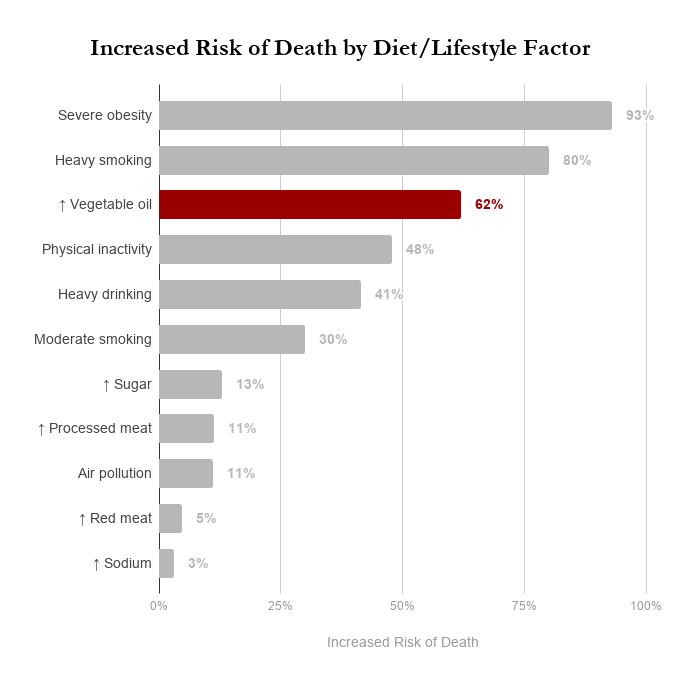
They’re the third most dangerous diet and lifestyle risk factor after severe obesity and heavy smoking. They increase your risk for strokes, heart attacks, cardiovascular disease and dying of cancer. They also are a potent source for dangerous chemicals like aldehydes and trans fats.
In a randomized 7-year study comparing people who consumed vegetable oils versus traditional fats (olive oil and butter), the group that consumed vegetable oils had a 62% higher rate of death. This makes vegetable oil consumption the third most dangerous diet and lifestyle risk factor after severe obesity (93% increased risk of death) and heavy smoking (80% increased risk of death).
In another randomized study observing people who consumed margarine with differing levels of vegetable oil, they found that the group that ate margarine with the most vegetable oil had 7x the rate of strokes, heart attacks and cardiovascular death.
In a third randomized study, where they kept the total fat the same but changed the % of vegetable oil, the group that consumed most of their fat through vegetable oil had a 82% greater chance of dying of cancer.
Vegetable oils are also a source of aldehydes and trans fat. Aldehydes are found in cigarettes and are linked to cancer, heart disease and dementia. The amount of aldehyde in 5 tablespoons of vegetable oil, the average daily consumption of Americans today, is equivalent to 25 cigarettes. Trans fat is banned from food products entirely as no level is deemed safe. Every 2% increase in trans fat consumption doubles the risk of heart disease.
The data is clear that vegetable oils are deadly.
Vegetable Oils Make You Gain Weight
Vegetable oil studies debunk the calories in, calories out theory and make it harder to establish healthy eating habits.
In a rat study where they kept total calories and macronutrient composition the same but changed the fat source (vegetable oil vs. traditional fats), the vegetable oil consuming rats gained 12.3% more body weight. For the average American, that would amount to 23 pounds!
In addition to making you gain more weight, vegetable oils make you crave unhealthy foods. The byproducts of vegetable oil attach to endocannabinoid receptors, the same ones that give you the munchies when you’re high. By mimicking the munchies, vegetable oils create a vicious feedback loop of consuming and craving salty, sweet, oil-rich junk food.
Vegetable Oils are High in Omega-6
Vegetable oils are high in inflammatory omega-6. Omega-6 is linked with chronic diseases such as Alzheimers, autoimmune diseases, diabetes, heart disease and cancer. Omega-6 also negates the healthy, anti-inflammatory effects of Omega-3.
Omega-3 helps in functions such as improving heart health, supporting mental health, reducing waist size, decreasing liver fat, supporting infant brain development, preventing dementia, promoting bone health and preventing asthma. However, it must “compete” against omega-6 to have an effect. Ideally, there is a 1:1 ratio between omega-3 and omega-6 in the body, but thanks the widespread use of vegetable oils, the ratio in Americans is between 10:1 to 20:1.
So to recap:
- vegetable oils have lots of omega-6
- omega-3 is good while omega-6 is bad
- omega-6 outcompetes omega-3
- more omega-6 = more disease
Vegetable Oils are Highly Reactive
Vegetable oils are highly unstable and create free radicals that damage tissue, DNA and proteins in the body.
The process of creating and re-heating vegetable oils results in oxidation, which leads to the creation of free radicals, which leads to cellular damage and disease.
Oxidation is the release of an electron. The loss of an electron in an oxygen-containing molecules creates a free radical. We can liken free radicals to unattended teenage boys. Free of supervision (the stabilizing electron and the reactions they normally partake in), they’re free to roam around and wreak havoc throughout the body. The more free radicals the body has, the more cellular damage occurs. The more cellular damages that occurs, the higher the risk of disease.
So Now What?
To recap, vegetable oils are dangerous to our health, sabotage our efforts to eat well, are high in inflammatory omega-6 and are a potent source of free radicals. Unfortunately, they’re also everywhere. Almost every processed package of food or meal you eat outside of your home contains or was cooked with vegetable oil.
Looking through my pantry, nature valley bars, probiotic apricots, organic corn puffs, organic Indian madras lentils, toasted sesame crackers, and mayonaise all contain vegetable oil.
A few others: oat milk, tortilla chips, margarine, Subway’s breads, Domino’s pizza crust ,Chipotle’s rice and everyone’s favorite Healthy and Earth-Friendly® product the Impossible Burger.
avoiding seed oils means you pretty much have to make every component of your meals from scratch
— chef neeraj (@NeerajKAfood) December 8, 2021
Ultimately it’s up to you do what you want with this information. But if there’s two main takeaways, it’s to minimize vegetable oil consumption and to be skeptical of the advice of food authorities.
For decades, health experts have instructed Americans in what foods were considered healthy vs. not healthy. Americans have largely listened, yet chronic disease is still on the rise.
The FDA introduced the food pyramid in 1984. It wasn’t updated until 2011.
Today they tell us vegetable oils are healthy and normal. “They’re low in saturated fat :)”. They also allow companies to mask the ubiquity of vegetable oils with pseudo-healthy labels like “natural”, “organic”, “vegan” and “keto”.
Sure a sunflower seed falls under all those categories. But is the process of grinding sunflower shells, applying immense pressure to squeeze out oil, before using hexane for further extraction natural, organic, vegan or keto?
Given the lobbying power of the vegetable oil industry, I doubt regulators change anything in the messaging or regulation of vegetable oils. Maybe one day we can have a Silent Spring moment and vegetable oils will be banned like DDT. But until then I’ll do my best to limit my exposure by eating real foods, cooking my own food, and avoiding brands that use vegetable oils.
If you want to learn more, I highly recommend reading the posts of Jeff Nobbs. Most of the information here is a re-summarization (some direct quotes) of his work to serve as TLDR version.